NOVI-SIM tomography simulation software

The software for an accurate description of the CT acquisition chain and realistic X-ray projection images

NOVI-SIM models the different parts of a CT acquisition chain, X-ray matter interactions and includes optimisation algorithms to reduce computation time.

With NOVI-SIM, perform virtual X-ray tomography imaging sessions!

Thanks to accurate physical models and an optimised implementation, NOVI-SIM allows you to test and adjust CT acquisition parameters. >> read about Novi-Sim models and benchmarking

NOVI-SIM is a valuable tool for training CT operators and engineers.

NOVI-SIM is particularly powerful in generating images to train artificial intelligence learning algorithms.

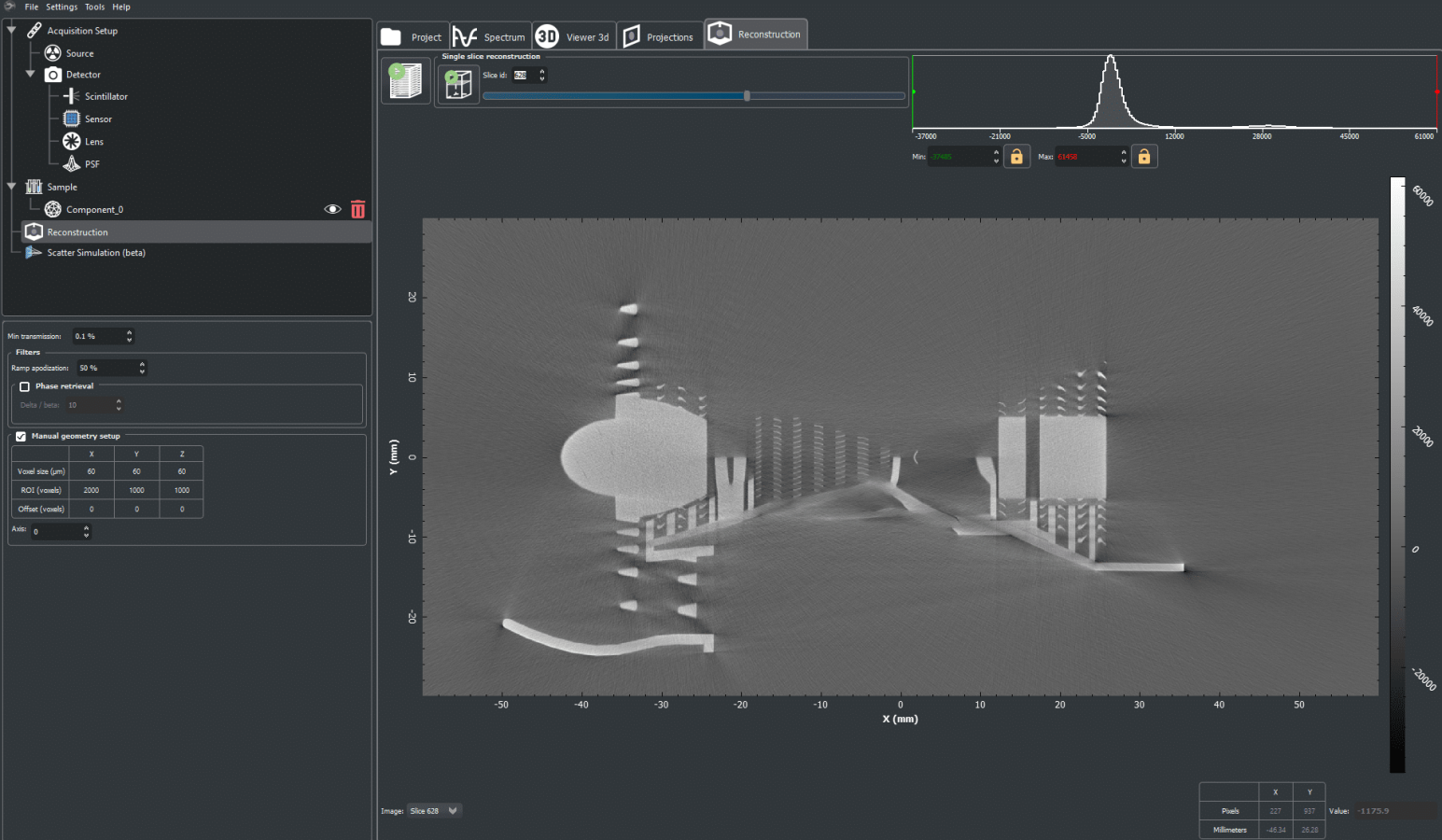
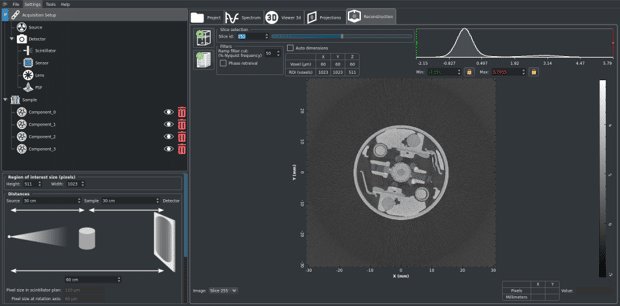
software_NoviSim_interface_reconstruction_turbine

A complete suite of modules is included in NOVI-SIM

Tomography configuration and acquisition parameters

  • Circular geometry
  • Helical configuration with number of turns, pitch per turn and rotation axis offset parameters
  • User-defined trajectories through scripting
  • Source <-> Sample <-> Detector distances
  • Exposure time / frame rate /accumulation
  • Number of projections
  • Range of rotation
  • Rotation axis offset

X-ray detectors: scintillator, sensor, electronics, MTF

  • Scintillator: selection of materials, thickness, density, gain, refractive index, user-defined materials
  • Sensor: selection of pre-configured sensors, pixel pitch, effective pixel surface, saturation, conversion, QE, readout noise, dark offset, dark current
  • Lens: if selected, coupling efficiency 
  • PSF: Gaussian PSF, Lorentzian/Cauchy MTF, empirical MTF

X-ray Physics

  • Primary radiation: Beer-Lambert law and ray tracing
  • Scattered radiation: a hybrid model enabling rapid calculations, based on the Monte Carlo method >> read about model benchmarking
  • Propagation-based phase-contrast
  • Attenuation coefficient are taken from the NIST XCOM database

Objects and virtual defects

  • Description of the sample: STL import or pre-defined geometrical shapes
  • Pre-defined shapes that can be used as is or inserted in objects as virtual defects
  • User-defined chemical composition
  • X-ray attenuation coefficients as published by the NIST and data are interpolated when needed.
 

X-ray sources: tubes, gamma, LINAC

  • Tubes – computed using Monte Carlo GEANT4 -GATE
    • Transmission (up to 278 kV)
    • Reflection (up to 1 MV)
    • Selection of anode materials
    • Definition of anode angle, thickness and material
    • Tunable current, power and kVp
  • LINAC or gamma rays
    • Monochromatic with energy and FWHM
    • User-defined spectra (incl. up to several MV)
  • Synchrotron beamline (option)
  • For all source types
    • Two-dimensionnal spot size (FWHM)
    • Filters between the spot and the object: user-defined materials and thicknesses

2D and 3D visualisation and reconstruction

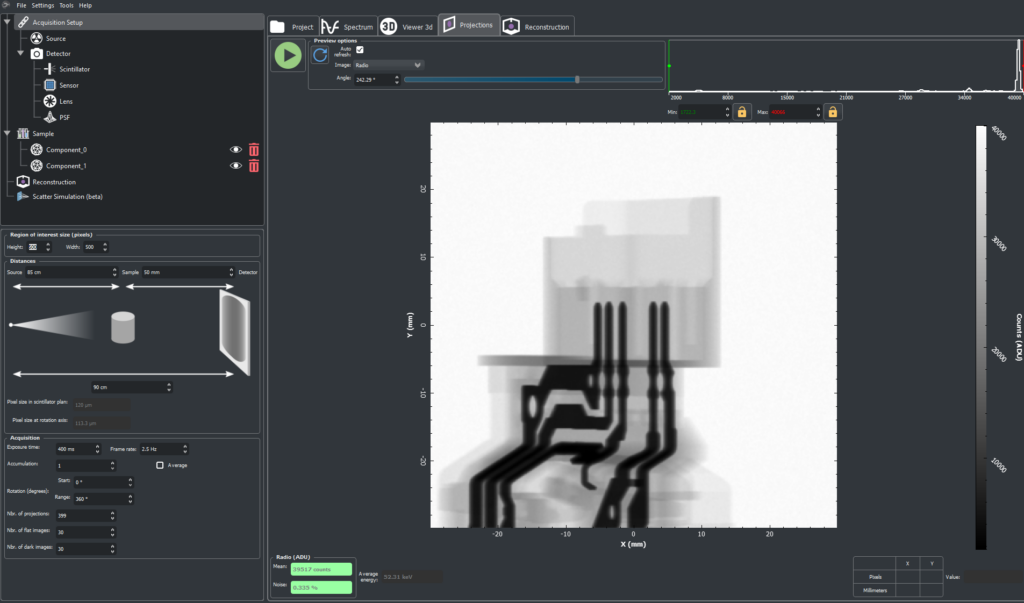
  • Live visualisation of radiography when updating a parameter or projection angle
  • Reconstruction module included, FDK, phase retrieval
  • 2D (slice) and 3D view with graphical options for the reconstructed volumes
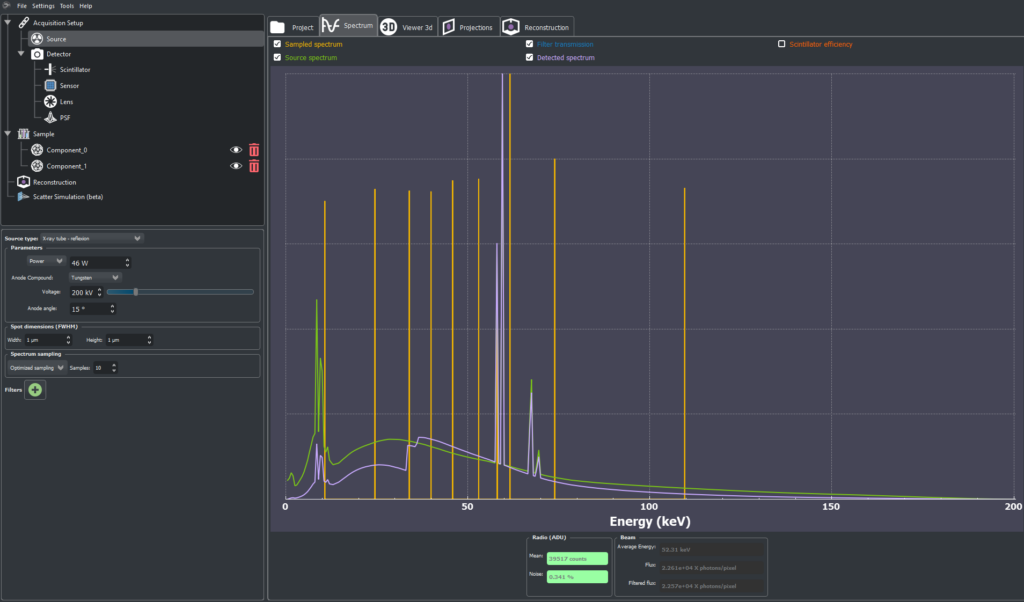
  • Plots available for X-ray source spectra, scintillator efficiency, absorbed spectrum at the detector level, objects’ materials transmission

The strengths of NOVI-SIM

Robust algorithms based on Novitom’s more than twenty years of experience in tomography.

Fast

Simulation of X-ray radiographs in seconds and volume reconstruction in minutes

Ergonomic

User-friendly interface and intuitive settings

Precise

Numerous adjustable parameters in the acquisition chain and experimentally validated models

Control and monitor radiography and CT parameters through NOVI-SIM's intuitive graphical interface

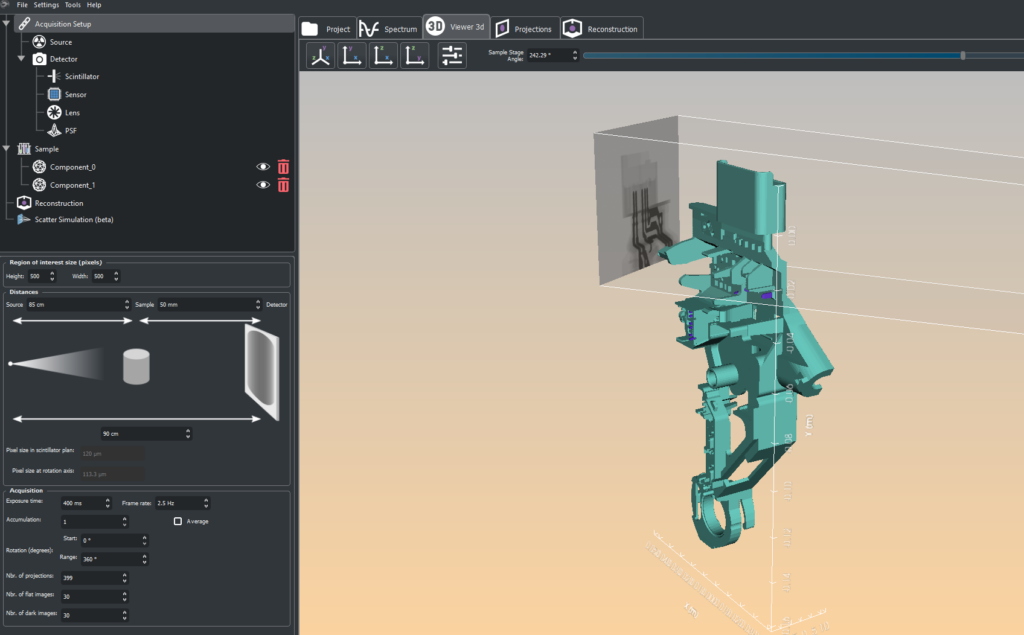
Set-up and 3D view of the tomography scene

Geometry and acquisition parameters as well as the Region of Interest (RoI) within the detector are defined by the user in the left hand side panel while the 3D view of the scene is simultaneously updating.

Live radiography update

Real-time updating of the projection (X-ray image) displayed when any acquisition parameter is changed (including source and detector configurations) or when the angle, position or composition of the object is modified.

Hardware characteristics

NOVI-SIM runs on any recent computer (less than 10 years old). User comfort depends on system performance. For tomographic reconstruction, an Nvidia GPU is strongly recommended.

  • Operating system: Linux (Ubuntu 18.04 and above) or Windows (version 10 and above)
  • CPU: 8 cores
  • GPU: Nvidia GTX
  • RAM: 16 GB
  • Storage: SSD with 500 GB capacity

References

 
Novi-Sim is cited in recent works (non exhaustive):
  • From Design to Inspection: Can Inspection-aware Design Enhance Reliability in Advanced Packaging?, IEEE Conference Publication, 2025, K. Yahyaei et al., DOI 10.1109/VTS65138.2025.11022922.
  • X-ADAPT: AI-driven design-based strategy to address x-ray compatibility challenges in advanced packaging metrology, 2025, K. Yahyaei et al., DOI 10.1117/12.3060349
  • Towards High-Contrast Table-Top Imaging of Integrated Circuit Defects via Tunable X-Rays, 2025, W.W. Lee, DOI 10.1109/IPC65510.2025.11282398
Novi-Sim X-ray tomography simulation software

Take the opportunity of a personalised presentation of NOVI-SIM!

+33 428 702 331
caroline.boudou@novitom.com

Articles and news about tomography

Novitom: supporting the nuclear energy sector

Novitom: supporting the nuclear energy sector

Novitom joins the Groupement des industriels français de l’énergie…

The microstructure of tablets revealed by synchrotron X-rays

The microstructure of tablets revealed by synchrotron X-rays

A recent study conducted by Xploraytion, Novitom, Merck and…

Optimizing X-ray CT with a virtual tomograph

Optimizing X-ray CT with a virtual tomograph

On September 13, 2023, Rigaku hosted an episode of…

Frequently asked questions about X-ray tomography simulation

What is Novi-Sim X-ray tomography simulation software?

Novi-Sim is an X-ray radiography and tomography simulation software that models the complete image acquisition chain, including the X-ray source, filters, sample, scintillator, sensor, optics and camera. It generates virtual radiographs and a reconstruction module is included to compute tomographic volumes.


What can Novi-Sim simulate?

Novi-Sim can simulate X-ray projections, i.e. radiographs, from any angle and supports circular and helical tomography scanning trajectories. It includes accurate physical models for absorption, phase shift and scattered radiation, along with tunable X-ray source and detector parameters.


Which X-ray sources are supported by Novi-Sim?

Novi-Sim simulates X-ray tubes (reflection and transmission) and monochromatic sources. User-defined spectrum can also be uploaded in Novi-Sim, especially for CT configuration using LINAC. Synchrotron radiation sources are also available in option. 


Can Novi-Sim simulate defects in materials?

Yes. Novi-Sim can model complex samples containing multiple materials and simulate defects such as holes, inserts and cracks. Mesh objects can be imported in STL format.


Can Novi-Sim simulate X-ray detectors and cameras?

Yes. The software can simulate a wide variety of scintillators sensors and cameras. Detection systems can be configured with the relevant parameters, including direct coupling for flat-panel detectors or coupling through an optical lens.


Can Novi-Sim be used to optimise X-ray CT acquisition parameters?

Yes. Novi-Sim can help optimise image quality and acquisition times by varying parameters such as X-ray current and voltage, source-detector distance, number of projections, exposure time, and local or global tomography configurations.


 How long does it take to run a simulation for a CT acquisition?

The first time you configure a given complete set-up, and depending on object complexity, it may require between 5 to 15 minutes, assuming you’ve collected all relevant information for the source, detector and object.

The modification of a given parameter results in a simultaneous update of the current displayed projection.

Computation time of projections depends on the number of useful pixels on the detector (that you can determine) and the number of cells (triangle) in the object. Typically projections are computed within a few minutes and reconstruction in less than a minute.