Chemical imaging

Mapping of species and chemical elements

If you are looking to identify and visualise chemical species, chemical elements or even their oxidation states in a sample, NOVITOM can meet your needs.

Our  selective chemical imaging techniques, which use the most powerful light sources, achieve unrivalled performance in terms of spatial resolution and sensitivity.

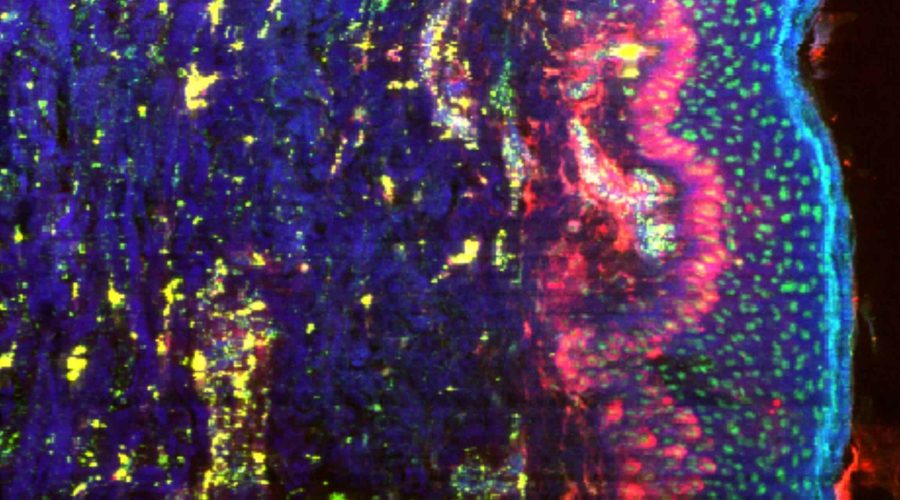
Cartographie des éléments chimiques réalisée sur une coupe histologique de peau: le phospore est bien visible dans le noyau des cellules, le fer dans les zones vascularisées (prolifération), et le potassium assez largement distribué.

Our expertise in chemical element mapping

Chemical elements

  • Identification and distribution of elements
  • Detection of pollution particles
  • Penetration of active ingredients into tissues


Degrees of oxidation and functional groups

  • Identification of the degrees of oxidation of a chemical element
  • Chemical speciation analysis
  • Oxidation-reduction analysis


Organic constituents

  • Identification and distribution of lipids in tissue
  • Analysis of protein conformations
  • Penetration of organic substances

Techniques used without any marking nor labelling

  • X-ray Fluoresence
  • SEM-EDX
  • XANES microscopy
  • FT-IR microscopy

NOVITOM: your partner dor R&D and material analysis

Reliable and rapid analyses

Analyses carried out on state-of-the-art equipment by a team of experts.

Tailor-made approach

An approach tailored to your constraints, with a technical contact person who supports you from start to finish.

Clear results

Actionable results thanks to detailed reports and 3D visuals that facilitate decision-making.

Further reading

The microstructure of tablets revealed by synchrotron X-rays

The microstructure of tablets revealed by synchrotron X-rays

A recent study conducted by Xploraytion, Novitom, Merck and…

Unveiling the impact of topical formulations on the organisation of skin lipid barrier

Unveiling the impact of topical formulations on the organisation of skin lipid barrier

X-ray diffraction reveals the structural organisation of the intercorneocyte…

Sample types

  • Histological cuts
  • Food products
  • Solid pharmaceutical forms
  • Any thin-section material