Analysis of CT scan data using artificial intelligence

3D image segmentation using deep learning and CNNs

X-ray tomography (CT, micro-CT) generates 3D image volumes that are extremely rich in information. However, extracting quantitative data can be complex when contrast is low or structures are interlaced.

Artificial intelligence methods based on deep learning, and in particular convolutional neural networks (CNNs), now make it possible to push the boundaries of conventional approaches and automate the analysis of tomography volumes with high accuracy and reproducibility.

Thanks to its pre-trained U-Net 3D network, NOVITOM provides advanced and robust image analysis services to efficiently process your volumes from micro-tomography, nano-tomography or industrial tomography.

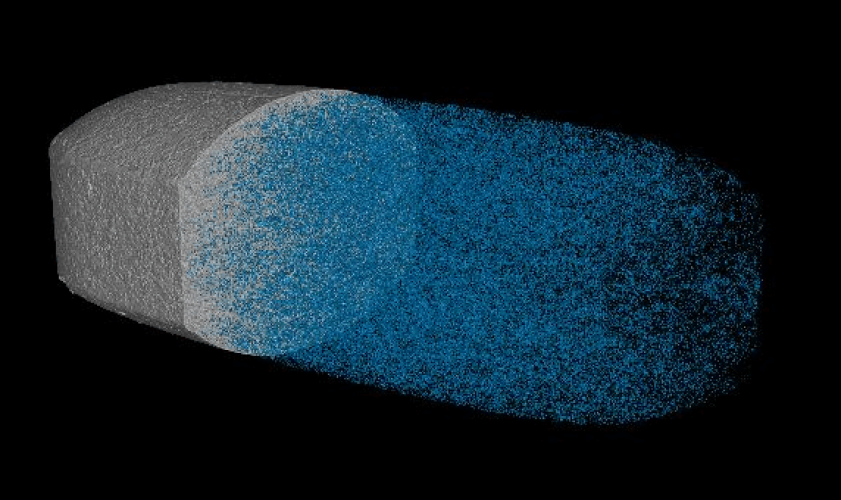
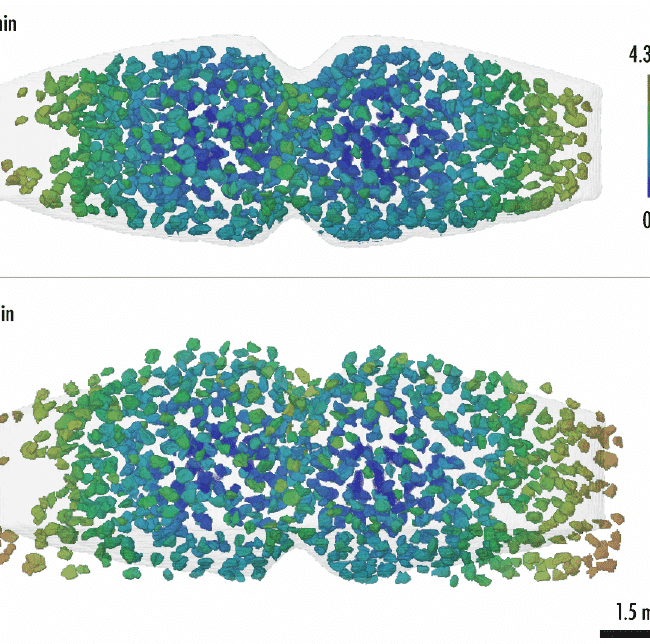
pharma_paracetamol_tablet_porosity_volume_rendering_tomography_dark

Key assests of AI-powered 3D image analysis

  • Segmentation of complex or ambiguous structures: proportion of total volume occupied by pores

  • Size and shape distribution: equivalent diameter, average size, sphericity, shape factor, orientation, Feret diameter.

  • Spatial location: position of pores within the component or structure.

  • Connectivity: distinction between open and closed pores, dimensions of the interconnected pore network, local thickness, tortuosity.

  • Dynamic evolution of porosity under mechanical, thermal or chemical stresses

  • Foam cells: cell volume, cell density, size distribution

Our AI-powered image analysis services

Segmentation of complex images

  • Very fine cracks or microcracks in metallic, ceramic or composite materials
  • Defects near the detection limit: small pores or inclusions, clusters of small defects
  • Irregular or blurred edges in noisy images
  • Objects with low contrast relative to the matrix (e.g. fibres, interfaces, inclusions)


Analysis of complex microstructures

  • Multiphase materials: identification of grains, inclusions, pores in alloys or composites
    Interlocking structures: microchannels, interconnected porous networks
  • Multi-scale materials: 3D printing, composites, sandwich structures, foam


Analysis of heterogeneous or natural objects

  • Heritage objects: sculptures, paintings or archaeological remains, to distinguish between materials or restorations
  • Natural materials: wood, rock, bone, biological tissues, where structures are organic and irregular
  • Complex biological structures: cells, vessels, neurons, multilayer tissues
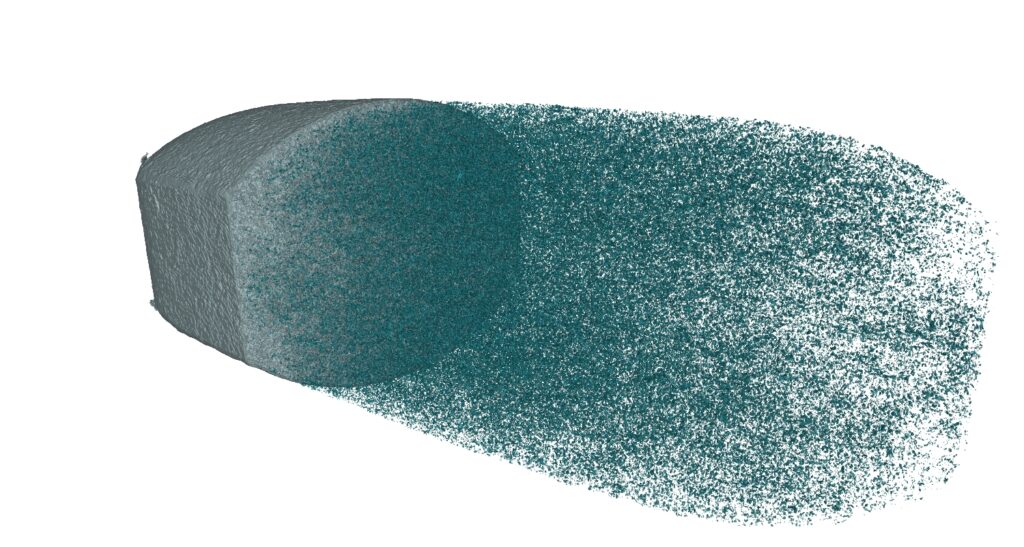
Rendu 3D de la porosité dans un comprimé de paracétamol, d'après un scan de tomographie

Automation, image quality and decision support using AI specifically pre-trained

Automation of quality control using CT scanning

  • Automatic detection of defects, including those invisible to the naked eye or using conventional methods
  • Inspection of large batches of parts with reliable and reproducible segmentation
  • Analysis of small or bulky objects where manual inspection is impossible or time-consuming
    Integration of the algorithms developed into the
  • LOGITOM platform to provide quality control software for installation at the customer’s premises


Improving the quality of reconstructed images

  • A necessary processing step for applications where the visual analysis of 3D volumes remains essential:
  • Noise reduction in 2D images or 3D volumes to improve segmentation
  • Correction of artefacts: beam hardening, gradients, rings
  • Enhancement of contrast or resolution to facilitate automatic detection

Database creation or structuring

  • You are already using AI to analyse your data but lack annotated CT images for training or validating your neural networks. NOVITOM offers:
    • Expert or AI-assisted annotation of 3D volumes
    • Creation of datasets for model training
    • Implementation of semi-automated annotation workflows


Development of bespoke AI models

  • Implementation of convolutional neural networks (CNN, U-Net, 2D/3D)
  • Transfer learning and fine-tuning on your specific data
  • Semi-supervised segmentation approaches to minimise annotation
  • Creation of reproducible pipelines (Python, TensorFlow, PyTorch, TensorRT)
rendu 3D d'une gélule dans son blister: l'emballage, la capsule et les granules ont été segmentés pour analyse

FAQ : CT data analysis and IA assisted image processing

* Can we trust AI-based image analysis?

Yes, the AI-specific algorithms we have developed deliver consistent and standardised results, regardless of the operator. This ensures the reproducibility of the analysis.

* Does AI analysis improve the quality of CT inspection?

Yes. Our specially trained algorithms make it possible to detect all internal defects present in the images. By applying criteria to the defects identified, we achieve a reduction in false negatives and false positives.

FAQ : Why choose AI image analysis ?

Reliability and reproducibility

Consistent, standardised results, independent of the operator.

Improved inspection quality

Detection of all internal defects in 3D, reduction in false negatives and false positives

Faster inspections and analyses

Automated analysis of batches or series of 3D volumes with drastically reducing processing time

Access to information otherwise inaccessible

Details within complex, multi-material objects and assembly, multi-scale analysis, irregular objects and interfaces

Drastic improvement in image quality

Efficient correction of beam-hardening artefacts, noise, super-resolution, etc.

Further reading

Tracking the evolution of materials microstructure : in situ mechanical testing

Tracking the evolution of materials microstructure : in situ mechanical testing

Why perform microCT during tensile/compression tests? The use of…

The microstructure of tablets revealed by synchrotron X-rays

The microstructure of tablets revealed by synchrotron X-rays

A recent study conducted by Xploraytion, Novitom, Merck and…

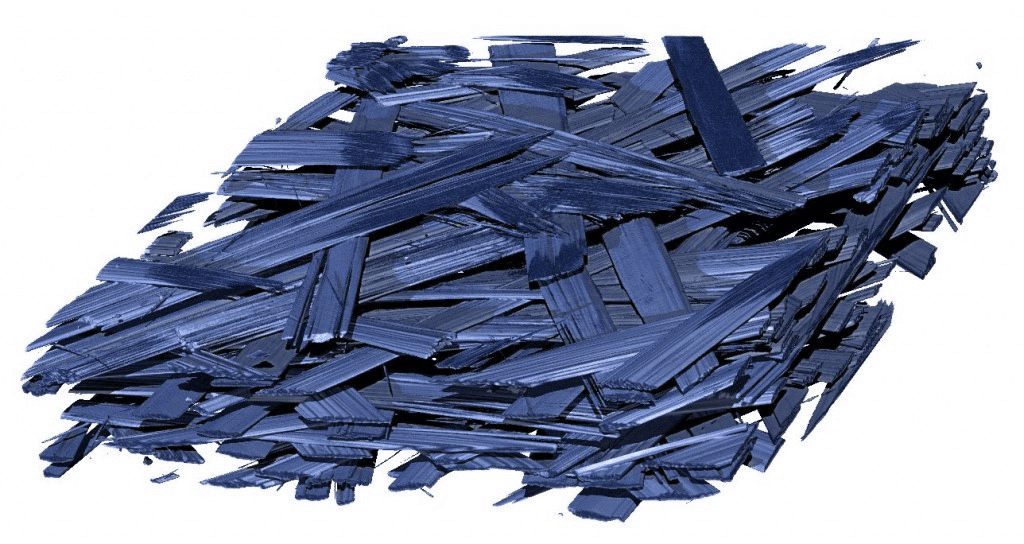
3D characterisation of fibres orientation in a composite

3D characterisation of fibres orientation in a composite

The images from X-ray microtomography (μCT) allow for advanced…

Our X-ray imaging techniques, image analysis and image quantification

For measuring both R&D samples and finished products:

  • Industrial computed tomography (CT): inspection of macro-porosity in parts up to several tens of centimetres in size
  • Micro-computed tomography (micro-CT): micrometre-level resolution for analysing internal microstructure and air bubbles
  • Synchrotron micro-tomography (SR-µCT): detection of even finer pores, rapid scanning of large sample series
  • In situ micro-tomography: quasi-static or dynamic monitoring of porosity changes under stress
  • Synchrotron nano-tomography: resolution down to 50 nm for the smallest pores

For visualisations and quantitative results tailored to your needs:

  • 3D visualisations: location, size and distribution of voids for clear and immediate inspection
  • 3D image analysis: precise quantification of the dimensions, shapes, connectivity, orientations, etc. of voids
  • AI-assisted analysis: detection and measurement of the finest voids or those within complex materials
  • Automation and reproducibility: standardised image processing and software transfer for comparable and reliable analyses
  • 3D film editing and animations: for clear and compelling presentations

Key assests of NOVITOM in AI-powered image analysis

Fast and easy analysis

thanks to the use of a single pre-trained CNN network, specifically designed for analysing CT images

A customised approach

tailored to your requirements, with a technical contact person who supports you from start to finish

Actionable insights

thanks to detailed reports and 3D visualisations that facilitate decision-making